The safeguarding blind spot every school shares
Young people today are shaped by influences broader than any generation before them. Pupils at your school are consuming digital content that none of us, parents or teachers, are aware of until it's a problem. That content doesn't just reflect who they are. It's shaping who they're becoming.
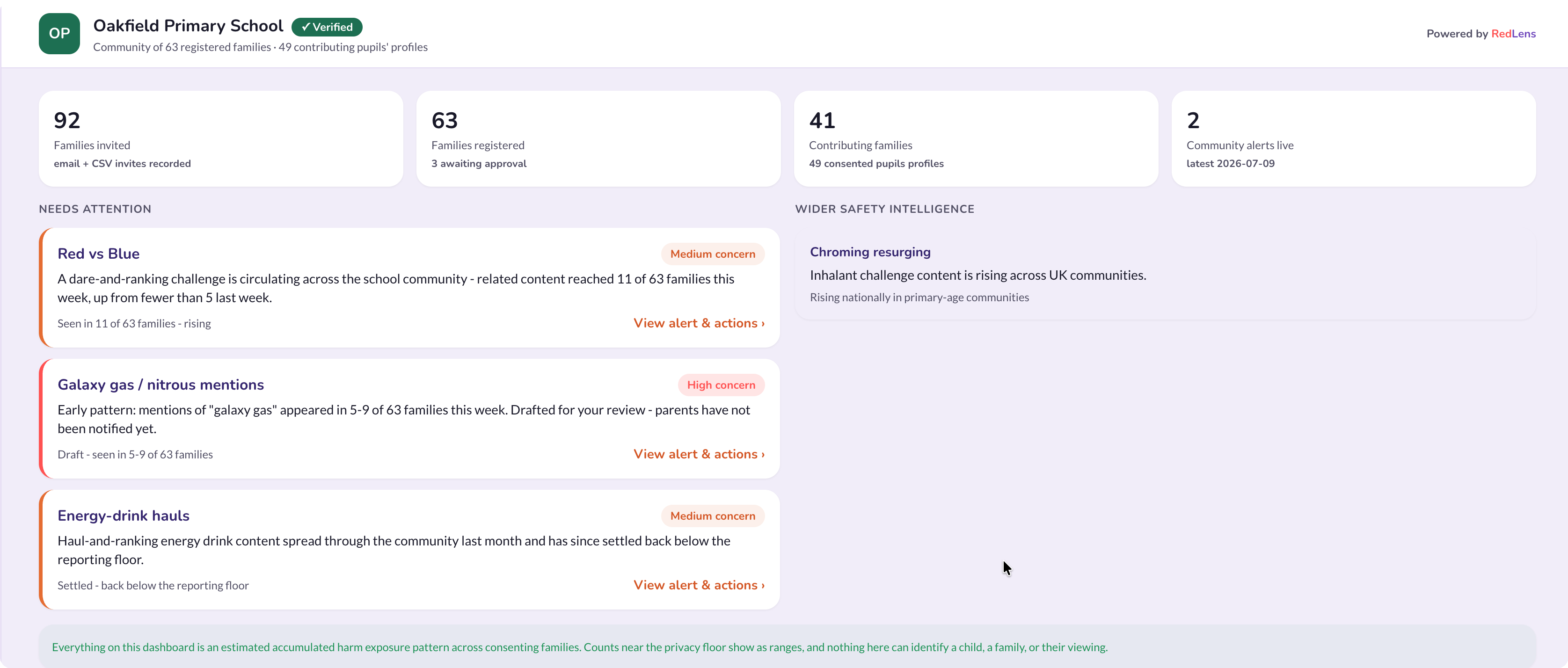
The adults around our children are managing the aftermath, not the cause
Chroming, an inhalant-abuse trend. Misogynistic content circulating among the boys. Self-harm and body-image content among the girls. A concerning clip moving through a year group in a matter of days. Parents, teachers and guardians see the fallout from all of this regularly, but almost never the warning signs that came before it, because those signals are personalised to each pupil, invisible to everyone else, and entirely outside anyone's view.
By the time it reaches them, it's already a crisis. RedLens brings that visibility forward, so there's a moment to step in before the crisis, not after it.
A practical early-warning layer, not another platform to manage
RedLens connects to a pupil's digital platforms (currently YouTube and TikTok) and turns what they watch into something a parent, and where a school chooses to use it, the school itself, can actually understand and act on.
- For parents: a plain-English view of themes, patterns and risks across 24 harm categories, with conversation starters and real-world activities generated from those signals.
- For the school (optional, opt-in): anonymised, aggregated trend data across a pupil community, so something concerning can be spotted before it reaches crisis point, without ever seeing an individual child's activity.
- For staff: ready-to-use email templates for parents, session plans for pupils, safeguarding-review summaries, and conversation points for assembly or form time, all written to guide the conversation rather than police it, and none of it ever pointing at an individual child.
None of this changes how the school operates.
Nothing is blocked, nothing is filtered, and no existing policy changes. The only addition is visibility into signals that were already there, surfaced early enough to act on.
Bans don't work. Visibility does.
The Online Safety Act and Ofcom's Children's Safety Codes put real duties on platforms, but none of it gives an individual school or family visibility into the signals behind what a pupil is being shown today. The evidence is increasingly clear that blanket bans and blunt restrictions don't reduce the underlying risk, and often just push children into less-supervised spaces. RedLens doesn't compete with whatever policy or filtering your school already has in place. It works alongside it, as understanding and guidance, not another rule to enforce.
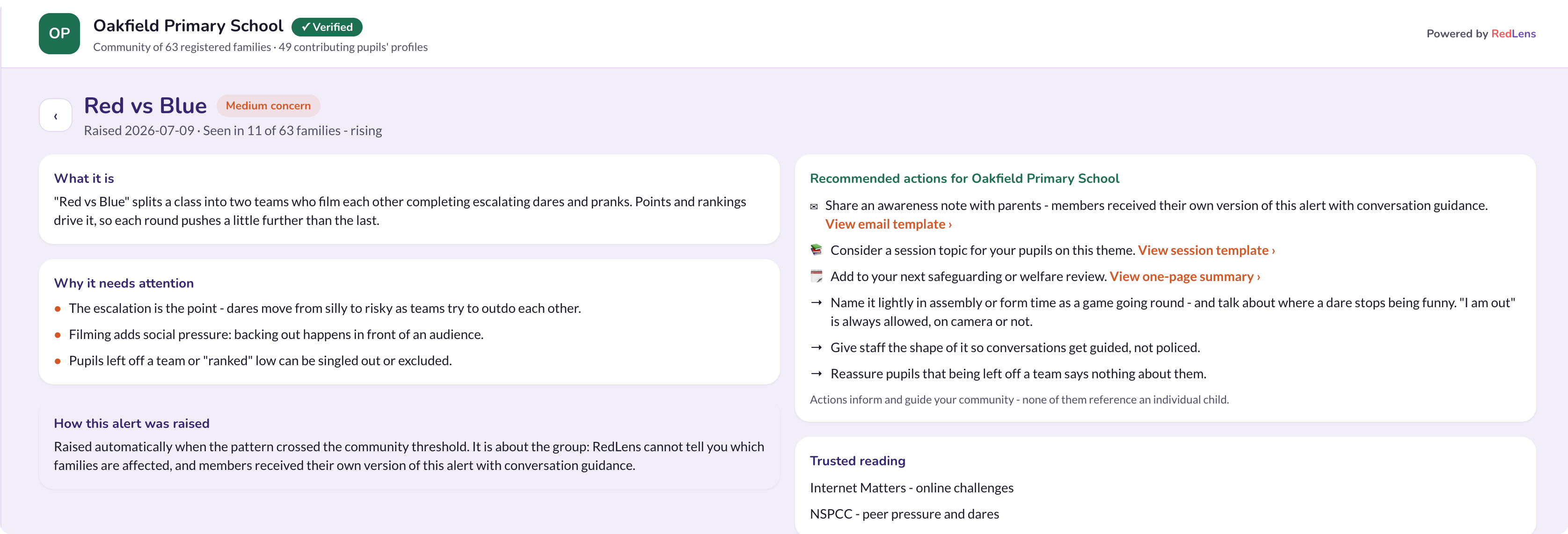
What this actually looks like for a safeguarding lead
This fits alongside the safeguarding routine a school already runs. Parents opt in, and the community view builds itself, surfacing issues only when they need a response, not another task added to the safeguarding lead's day.
If something like a chroming trend starts spiking across a year group, the safeguarding lead receives an alert immediately, not buried in a digest. Each alert includes:
- a ready-to-send parent email
- a suggested response plan
- a classroom or assembly session plan, where appropriate
Individual pupils are never identified. No more data leaves the platform than is needed to raise the alert, so it sits comfortably alongside your existing data protection policies and safeguarding responsibilities.
Straightforward about scope
RedLens currently works with YouTube and TikTok, covering the platforms where most of this activity actually happens. We're upfront that Meta (Instagram, Facebook, WhatsApp) does not currently provide the data access needed to do this responsibly, which is itself a useful thing for a school to be able to tell parents.
How an early pilot would work
We're looking for one or two independent schools to run a small pilot with an initial group of interested parents, with your school's safeguarding lead as the single point of contact throughout. No cost during the pilot, and no obligation to continue.
Start the conversation
If this looks relevant to your safeguarding priorities this year, we'd welcome a short call and a live demonstration. No commitment, just a short meeting to see if it's worth a longer look.